
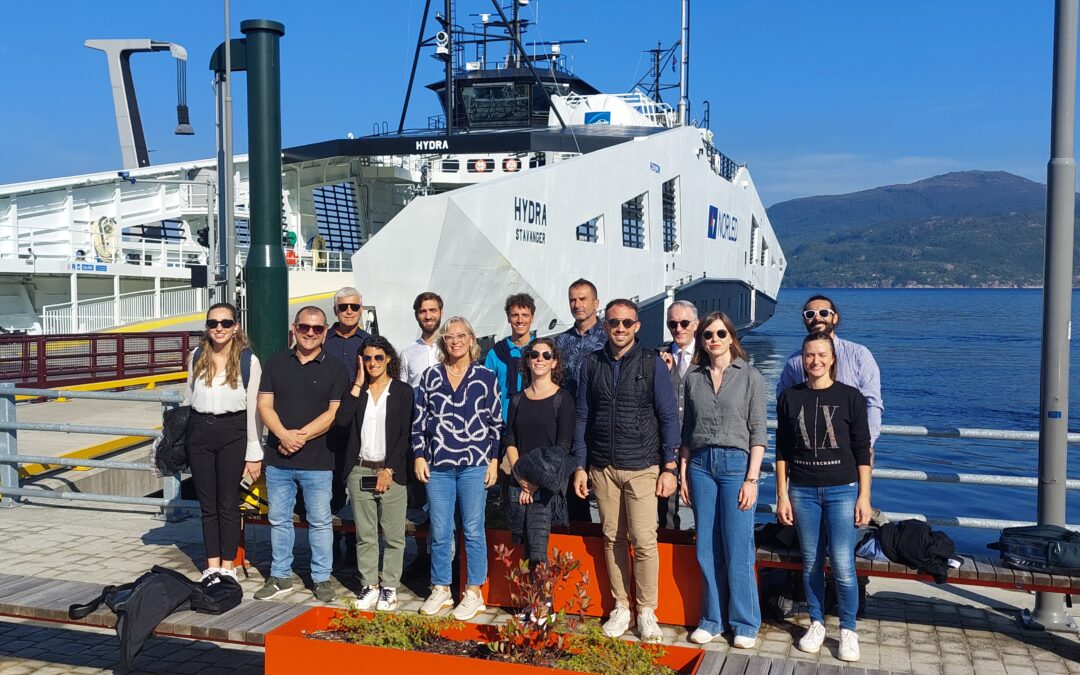
In early September, a delegation from Navalprogetti, led by Irene Lavagnini and Filippo Rezzante, took part in a study visit to Norway organized by MareFVG. The visit, within the framework of the TransH2 project funded by the Interreg Italy-Croatia Program, focused on exploring hydrogen technologies and research related to maritime transport. This opportunity enhanced collaboration within the partnership, which includes regional partners such as Regione Friuli Venezia Giulia and the University of Trieste.
Bergen’s Ambitious Plan for Fossil-Free Energy by 2030
One of the highlights of the visit was learning about Bergen’s ambitious plan to become free from fossil fuels by 2030, ahead of the Paris Agreement timeline. This plan includes fully electrifying the docks and promoting incentives for less-polluting vessels. The city’s commitment to sustainability set an inspiring example for the rest of the industry.
Vestland County’s Efforts in Maritime Energy Transition
The delegation also explored the efforts of Vestland County in driving the energy transition for maritime public transport. Vestland’s feasibility studies and cost-benefit analysis have helped identify the perfect balance between conversion costs and long-term benefits, optimizing energy vectors, fleet management, and routes to reduce emissions.
Research and Collaboration Opportunities with Innovation Norway
In addition to the technological advancements, the delegation discovered a wealth of opportunities for collaboration between Norwegian and European companies. Innovation Norway, the government agency responsible for promoting international partnerships, plays a crucial role in fostering these cross-border initiatives.
Visiting NORCE and the HyValue Research Project
A key stop during the study visit was NORCE, a research institute actively involved in the HyValue project, a joint venture focused on the entire hydrogen value chain, including production, distribution, usage, safety, and regulation. This project aligns with the North Adriatic Hydrogen Valley initiative. During the visit, the delegation toured NORCE’s laboratories, where hydrogen storage methods (such as pressurization) and microbial hydrogen production were explored, revealing the diverse sectors involved in hydrogen research.
MF Hydra: The World’s First Hydrogen-Powered Ferry
The delegation’s visit concluded with a tour of MF Hydra, the world’s first hydrogen-powered ferry, a groundbreaking vessel that has reduced its carbon emissions by over 95%. Owned by NORLED, one of Norway’s largest ferry operators, MF Hydra can carry up to 300 passengers and 80 vehicles, operating up to 42 daily routes at a cruising speed of 10 knots, linking Stavanger’s rural villages. The tour of the bridge and engine room provided valuable insights that will support the next phases of the TransH2 project.
This study visit has not only provided valuable lessons but also fostered a stronger partnership between regional stakeholders and international research communities, paving the way for future innovations in hydrogen-based maritime transport.